Fly Fishing Traditions


Fly Fishing Traditions Blog and Website
"It's about Life & Fly Fishing"

Saturday, November 29, 2014

Kingfisher Drift Boat Build - Drain Plugs


Now that the LineX bed-liner is sprayed on the bottom it's time to install drain plugs and wood inserts where I need to attached various parts to the bottom. The bottom is constructed with Plascore, a honeycomb plastic material. Screws will not attach to it. So essentially I have a 3/4" thick plastic bottom with Kevlar and fiberglass on both sides. I need to epoxy and glass in some epoxy sealed Okoume plywood discs to enable me to attach stuff.

I used 3 different sizes of hole saws mounted in a drill press to make the discs.

2 1/2" Diameter Discs. 

The first discs where 2 1/2" in diameter. These would be used for attaching pulleys for the anchor system. I will be inserting one in the transom and two under the front of the rower's seat. The ones under the rowers seat are placed butting up to one another.


Here are the two side by side holes under the rower's seat where a pulley will be attached. I used a 2 1/2" hole saw to cut through the top layer of Kevlar and fiberglass.

2' Diameter Discs

The 2nd set of discs were 2" diameter. These would be used to secure the foot brace brackets in front of the rower's seat. There will be 4 of them.


Here is a photo of a 2 inch diameter hole that has been drilled and then the plastic honeycomb removed 

The holes are bored with a 2' diameter hole saw just through the top layer and then the honeycomb core is removed by twisted the core out with a pair of needle nose pliers.


2' Diameter holes for the Drain Plugs

The drain plugs require 2 holes to be bored. I started off by drilling a 2" diameter hole through a piece of 1/2" thick Okoume plywood with a 2" hole saw. The holesaw has a 1/4" diameter pilot bit. Once drilled, I changed to a 1" diameter hole saw. I held the 2" disc in a clamp and used the 1/4" pilot hole to drill a 1" diameter hole inn the center.


The photo above shows the 2" diameter discs on the top row and the plug for the drain plug on the bottom. The brass drain plug is inserted into one of the discs.

Sealing and Installing the Discs

The discs were sealed with epoxy on all sides prior to installing them. They were then sanded with 120 grit prior to installing them. Once sanded I mixed up some epoxy peanut butter and epoxied the discs into their appropriate holes. The epoxy peanut butter was squeezed out of the holes as they were leveled. The epoxy was leveled and cleaned up and left to harden overnight. The next day I cut squares of fiberglass cloth and placed them over the plugs and flow coated them.


This photo shows the 4 - 2" diameter discs epoxied in place

Installing the Drain Plugs

Once the wooden discs had set up I had to drill through the LineX bottom. I used a 1" diameter steel bit. The bit scored the holes a bit so I recoated them with epoxy Once the epoxy had hardened the plugs were ready to be installed. The brass drain plugs were installed with 3M 5200 adhesive. The bottom flange and the outside surfaces of the drain plug were coated liberally. Once the plugs were inserted I used #8 x 5/8" brass screws to attach the brass drain plug to the wooden disc. I put 5200 adhesive in the screw holes.


This is a photo of the drain plug disc in the transom prior to drilling through the bottom. Note that the disc is about 3/16" below the surface of the bottom. This will flush out the drain plug flange.

Thursday, November 27, 2014

2010 Fall Fishing Tips - A Summary


The Fall Lower Yuba Summary

With the pounding we've taken prior to this Thanksgiving week, with snow storms knocking out power, breaking down oak and ornamental trees that still had leaves on them, I guess we can say winter has arrived. I'm sure we'll still see some Indian summer like days in December, but for all intents and purposes the fall is over and we need to look towards winter type conditions when heading out fishing. I thought I'd sort of sum up the 2010 fall fishing here on the Lower Yuba River.

The salmon came in early and in pretty big numbers, so the egg bite was pretty good. I made it out about once a week and so my experiences are based upon that. Some regular guides on the river have felt that it was one on the better fall seasons for the egg bite in a awhile. My experience was that it was a little tougher than last year, but like I said, I'm not out on the river everyday.

My conclusions after fishing the river pretty hard in the fall of 2009 and from this fall are as such.

  • I believe that when the salmon are in the system and the resident rainbows are staged behind them, the best fishing happens early in the mornings before the sun really gets high. This is especially true when the water is low running at 900 cfs +/- and gin clear.
  • The later the day gets and the more drift boats go down the tougher the fishing gets for fish staged behind the salmon and the river in general. First Down equals best fishing.
  • It is my opinion that the fish move into deeper slots or more aerated water for sanctuary as the day gets brighter and with more fishing pressure.
  • The above, I believe, holds true unless you get an overcast day. On overcast days the fishing can be consistent and the fish seem to be where you'd think they should be throughout the day.
  • Troutbeads are the Bomb, especially if you steal nail polish from your wife or girlfriend, for the troutbeads.
  • Don't forget about the bugs. The fish will still eat bugs, collect a sample, match the color and size of what you find, Stones, Caddis and Mayflies. Keep up good principles.
  • Don't believe everything you hear at the fly shop, or from your buddies, do your sampling, look to the river to tell you what to do, experiment and keep trying!

Tight Lining

This year I've started stripping off the indicator more often and using less weight and using tight line nymphing techniques in the rollers and shallow runs up to four feet deep. I have more confidence in using straight line casting techniques in the rollers behind the salmon and keeping tight to the flies. Cast on top of the bucket or drop off, using enough shot to tumble the flies down into the bottom of the bucket. If there is not take, pick it up and recast to the next likely spot. This method is of course from a moving drift boat. Using this technique also works just as well when wet wading. Just don't wade in the redds!

When the depth of a run is 2 feet to 6 feet, you can also fish it effectively tight lining, just make sure you put on enough shot. The amount of shot is the key. We have consistently had success in these depths when tight lining, but you must feel the shot bouncing on the bottom from time to time. If not add a BB. If not add another BB. Get the picture.

We picked up the some of the biggest fish of the year using tight line methods in 2 foot or less deep water.

Indicator and Shot Method

I still like to put the indicator right back on as I work the deeper runs that have a consistent depth of 4 feet or more, This is more of a bug bite thing than an egg bite, although the numbers of fish caught using this method in the runs, the eggs still out perform the bug imitations throughout the fall. Dead drift them, mend properly, make sure you've got enough weight on. You've got to get and stay down.

If I don't take the indicator off when fishing tailouts or buckets, I'll straight line cast it and fish it tight line as if the indicator wasn't there, If you do this you have to pick it back up and re-cast to keep it fishing correctly. Sometimes I'll do this if there is a quick tailout or some redds with a deeper run right below it. This is really just being lazy but as you know it's easy to let happen. Theory is one thing.

Typical Rigging

My Fall standard rigg for indicator or tight line nymphing is;

(a) Start with a 3x, 7 1/2 or 9 foot foot leader
(b) Add 18" of 3x tippet and put shot above this knot
(c) Tie on an egg pattern of choice
(d) Add another 18" of 4x tippet tied to the hook bend of the egg and then tie on a bug of choice.
(e) Add another tippet of 5x tied to the hook bend of the 1st bug and then tie on another bug which is usually the smallest one.

The typical sequence goes egg, attractor nymph, usually a caddis, and then an imitative nymph at the end. I'd usually rigg both anglers starting with and egg, one with a Troutbead and one with a Pettis Egg, and 4 different nymphs. Then we'll switch it up if we've found out what the trout wants on any given day.

This leader works for tight lining or indicator nymphing. Just add a Thing-a-ma-bobber.

The Flies

As far as discussing flies, I'm considering the fall starting when the salmon first started showing up this year in August, these were the occasional springer salmon that are in the system. It really seems that as long as there are salmon around, even if they are spawned out or pre-spawning, the trout will eat and look for eggs, much earlier in the season than you might think. For the most part if we see a salmon, an egg goes on. Once an egg goes on in the fall season, it pretty much stays on the whole season in different types, sizes or colors. It's what a guide friend says, "It's Steak and Eggs Time".

The Troutbeads still were the best egg imitation, especially if you take the time to paint them with finger polish. I had good luck using Pettis Eggs early in the season, but the Troutbeads out performed everything for the middle and end of the fall.

In early fall we had real good luck with copper johns, and just about anything black, a black Copper John, Prince of Darkness, AP Black, Hogan's Yuba Pupa, Fox's Poopah, pretty much any standard caddis nymphs in olive etc. We had some exceptional fishing these bugs with an egg as a dropper in the tailouts above the Parks Bar Bridge.

We also had very good luck in the early fall with eggs and the above mentioned nymphs, in areas of the river where the river tailed up in run, from say 8 to 12 feet to 6 feet. The fish would sit right at the bottom of the up lift and be staged for nymphs moving toward the lifting gravel. They would take eggs and bugs about equally.

As the fall progressed we typically used a Troutbead, an olive caddis, and then a mayfly nymph. Pheasant Tails, Hogan's Military May's in Brown and Olive, Hogan's Yuba Pupa, Fox's poopahs in cinnamon and green. We had luck with a Spitfire one day which was a first for me.

When we found that the water was off colored from a recent rain storm we would go, Egg, Rubberleg Stone, and then a nymph of choice. We had some real good days when the visibility was about 4 feet or so. The off color provides a level of stealth that you just don't get with the spring creek clarity of the river flowing at 900 cfs +/-. When the river gets that off color look, try to get out there the fishing. The fishing can be great and typically brings up the adult steelhead, or resident rainbows, whoever's opinion as to what they are, you want to listen to. All I know is that, they are bigger and are fighters. We managed a few of these to the boat and lost some we never got a look at, but that's fishing.

All told, it was a great 2010 fall fishing season with friends, and many stories told, fish caught and lost. Although, as always, work always seems to keep me from getting out as often as I'd like. Maybe that won't be the case next year.

Have fun out there!

Tuesday, November 25, 2014

Trinity River Steelhead

Thanksgiving Day, 2009 - Happy Holidays


It's finally feeling like winter is on its way here in Grass Valley. The air has a crispness to it that only comes as fall turns colder to winter. We're getting the organic turkey ready to put in the BBQ and family is on its way. My Mom and Dad are coming from Idaho and Laura's brother Mark and his family and kids are coming the day after. Zack is excited to have his three cousins over to play around with. The kitchen will soon be filled with the aromas of a savory dinner in the works.


My thoughts have been turning over the fact that it will be prime steelhead season on the Klamath and the Trinity River as soon as the weather really starts to turn and move in. November and December are usually the prime time. I really should hit the Trinity as I fished the Klamath with Zack about a month ago. In years past, I've hooked up with my friend and guide Mike Hibbard and fished the Trinity this time of year, but he's now booked every day from the beginning of October through some time in January. He has repeat clients that book the same time slot more or less each year. Sort of hard for me to comprehend booking a trip a year in advance. I always thought that when the steelhead were in and the time was right you headed up to Junction City and went fishing. What if the fish are not in? What if the weather is terrible and you'd be fishing in a snowstorm? I guess it's steelheading, you pick a day a year in advance, plan it and go. It could be epic, you may have to hunt down and find the fish and figure where they are in the system and if you get skunked that's also steelheading. I guess that's the way it's becoming with all the good guides on the Trinity. I guess I'll just have to hitch up my "Fishcraft" raft, get a couple of buddies to share the gas money and head up there one of these days.

I've heard from many sources that in the last couple of years the fishing on the Trinity has turned into "Combat Fishing," with it hard to find open water to fish. The steelhead runs have been very good the last two years so every one and their brother is there trying to hook up a steelhead. This is actually why I didn't go last year. The last time I went down the Trinty River, was two years ago in mid November, I went with my friend and fishing buddy, Blake Larsen. We were fortunate enough to hook up with Mike again. If I remember right, we were able to fill in a spot that was canceled by a client of Mike's. I got the phone call and we went. We got to the put in around Junction City at about 9:30 and there were a number of drift boats already on the river. We headed down the river in Mike's drift boat and there were other drift boats and wade fishermen in every slot and run for at least a mile, but it's kind of hard to tell distance when you're drifting along. As Mike rowed down the river he told us of a story where a guide from "The Fly Shop" in Redding showed up and rowed the whole river from the put in to the take out and was not able to find a spot to have their clients wet a line. That's what they mean by "Combat Fishing."


Mike was hoping that no one had got that far down stream yet and as we rounded a bend in the river Mike muttered, "All Right, nobody's home". We parked the boat and got out and started fishing one of his favorite runs. Anyone else coming down the river had to keep moving further on down and leapfrogging to find open water.


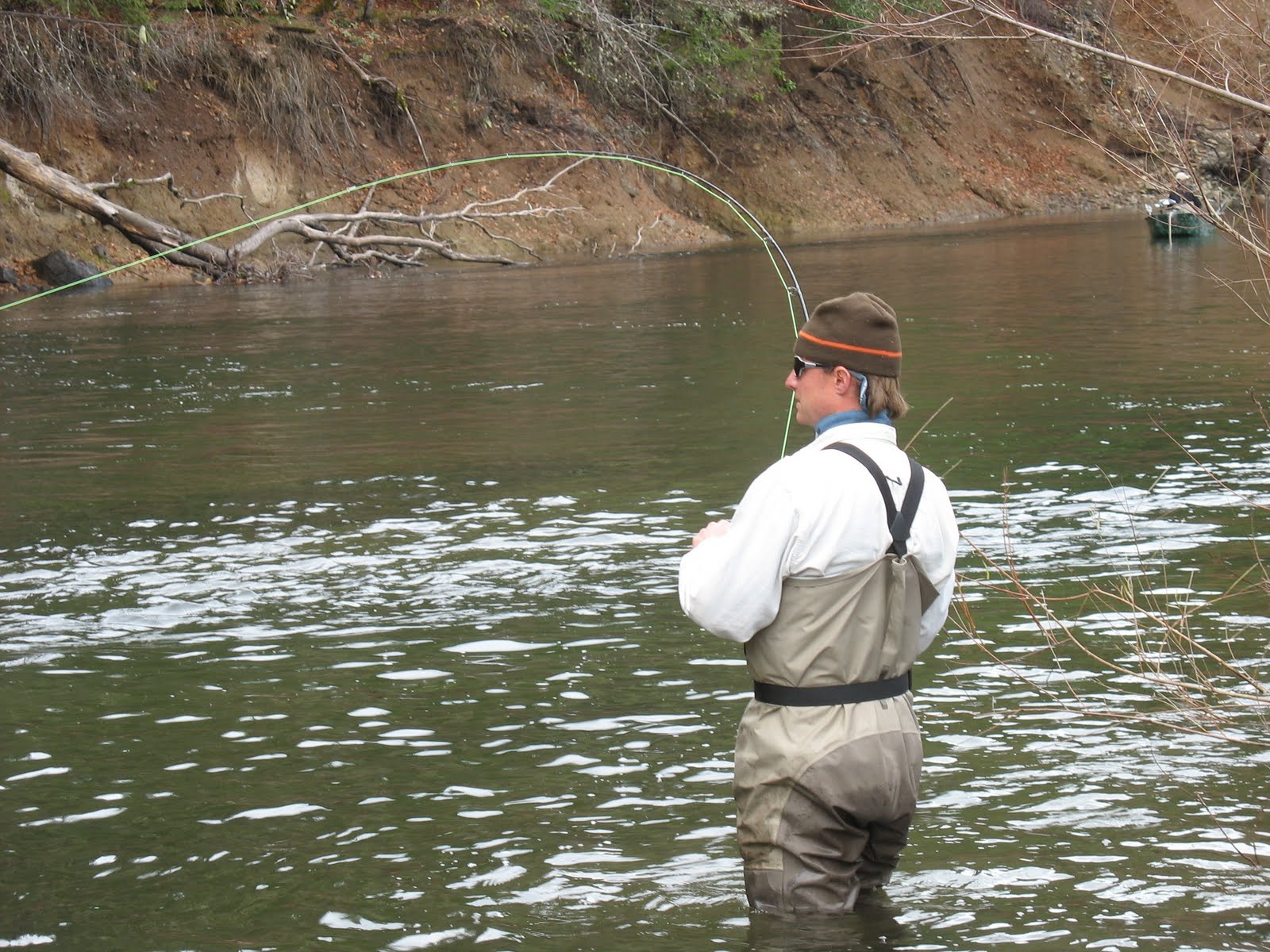
On that day, the weather was fairly warm and overcast, so we were looking forward to the possibility of a successful day. We were lucky enough to find this prime open slot and this run lately had good numbers of steelhead in it. We parked the drift boat, spread out and fished that run for what seemed like 4 or 5 hours. I stationed myself at the head of the run where the riffle dropped into a slot and Blake set up to fish the run futher down stream. I think I was "schooled" about five or six times before I finally got a nice steelhead in my hands. I was fishing at the head of the run feeding my indicator and flies downstream into the slot. There was a dropoff and the steelhead were stacked there. I was fishing with an indicator, plenty of shot, an egg, a sort of purple/blue Copper John and a Mercer's Poxyback Stonefly. The fish would hit, the indicator would go down, I'd set and all hell would break out. The fish would run straight at me. I was having a hard time managing my set and could not keep up with the steelhead running right at me. As soon as I got the slack under control and felt the fish, gone! They would shake out the hook. This happened about 6 times. Mike was coaching me how to strip set and keep my reel and stripping hand at my chest and try to set sideways and low. But for me at the time it was not computing. When a 10 pound steelhead hits everything that I was being coached with went out the window. Mike would just laugh at me and just would say "Keep after it, you'll get it." Eventually I did and started landing fish.


On this subject of setting and fighting fish, if you ever get a chance, you should check out a video by Kelly Gallop, "Streamer Fishing for Trophy Trout with Kelly Gallop". This video has a section where he talks about how to set and fight fish and talks about rod position and hand position. "Keep your hands in a box." His pointers are applicable to almost any type of fishing. It's the best example I've seen of what Mike was trying to work with me on the river. But once again, you may rationally think it through, but when a freight train of a steelhead hits, all the should of, could of, goes out the window. At least it was for me for a while, until my adrenaline settled down and I finally got the hang of it.


I was fishing with a Sage Z-Axis 6 weight and after I settled down I hooked a fish that went 10 maybe 12 pounds. I imediately thought why the heck didn't I bring my 7 weight. It took me down stream into a deep pool that was probably 20 feet deep. the water was crystal clear and this steelhead just dogged it on the bottom. I couls see the fish the whole time which made it sort of nerve wracking. It was like I was hooked to a log. I could hardly move it. Mike was coaching and said, "You've got to start pumping him up and putting pressure on him or you'll be there all day." So I did, I'd reel down and pump up, reel back down and pump up. I'd do this and slowly the fish would come up, only to race back upstream and then I'd have to start all over again. I finally was able to get it to come it up, but it still wasn't close enough to net and down it went again. By this time my forearms were burning and I seemed way under gunned with my 6 weight. I really thought I was going to break it. When I finally got it close again, the fly popped out. Gone! Mike just said, "Let's go get another one."


It the meantime, Blake was fishing below me in a section that was shallower and more of an even "walking speed" run. He would hook up and the fish would typically turn and run downstream. He was being much more successful landing fish than I was and he let me know it. That's what friends are for, right? The angle that Blake was fishing from enabled him to set sideways which provided a solid hook set and put pressure on the fish almost immediately. The fish hooked in this part of the run would either shoot upstream and then turn and gradually start moving downstream or they would feel the hook set and turn and go downstream immediately. He could then work the fish into shallow water and tail it or have Mike come down and net it. This current speed was also helpful to hooking, playing and landing the steelhead from this area. This is probably justification by me for not landing as many fish. But what the heck, I think it’s true!


Mike was kept busy coaching me and helping Blake and I land fish, once I figured out my hook set. We hooked and landed fish regularly, How many? To be honest I really don't remember but it was plenty. If I remember right Mike rigged Blake up with an egg on the point and then trailed with a larger nymph, like the Blue/purple Copper John, and then trailed that with a smaller nymph like Morrish's Anato-May. This I am sure of. The Anato-May was a hot fly all day.


We still had about 3 or 4 miles of river to fish so we packed up and headed downstream at about 1:30 or 2:00. We would side drift the runs the rest of the way to the take out. We would float down a riffle and Mike would eddy out the boat and anchor and we would fish the slots from the boat and then keep going and side drifting as we moved downstream. We hooked and landed more fish doing this.


The fish that I remember most on that day is the one that got away. Go figure! We had just drifted down a very shallow riffle that the boat had banged it's way through and were fishing a bouncy slot along some willows that was about 3 to 4 feet deep. I had shortened up my indicator and we were side drifting the slot, my indicator went down, I set the hook and the fish tore up stream, while the boat was still going down. Mike eddied out and the fish ran up through the shallow riffle that we had banged through and you could see the steelhead's whole back out of the water as it ran up. Big! Mike quickly rowed back upstream as far as he could. I thought that it was a goner but I kept pressure on it and hoping. It gave up and turned around and started back down stream. This fish probably went 14 pounds. Who knows? It tore downstream and Mike followed it. The fish then headed river right where there were two downed trees with root balls and limbs underwater. It was a tangled mess. Where did it go, straight for the sticks. I did all I could to keep it away but no luck. Mike rowed downstream and we could see the fish downstream of the snags. The only problem was that my line was snagged in a branch between the boat and the fish. Blake jumped out of the boat with the net and somehow got the line loose. As soon as this happened the fish moved into the middle of the river where the current was the slowest. I thought to myself, "we may actually land this bugger." The fish didn't stop. Directly across the river was a tree with a big root ball at the bank. This fish them swam straight to the root ball and stationed itself under the thick of it. Mike rowed the boat over and there it sat, directly in the middle of this mess with my tippet again tangled in the branches. It was six feet from the boat but there was no way could we net it. All I had out of the guides was the indicator and tippet. I stuck my rod tip under water and tried to work loose the tangled tippet. As soon as the fish felt the slack, the fish just bolted upstream. Gone! Game over! Mike made a comment something like "I've never seen a fish that pulled off a stunt like that." It's my clearest memory of that eventful day. Funny how that is.


Blake landed this beauty further downstream when we drifted through a riffle and just entered a nice slot. Kudos!


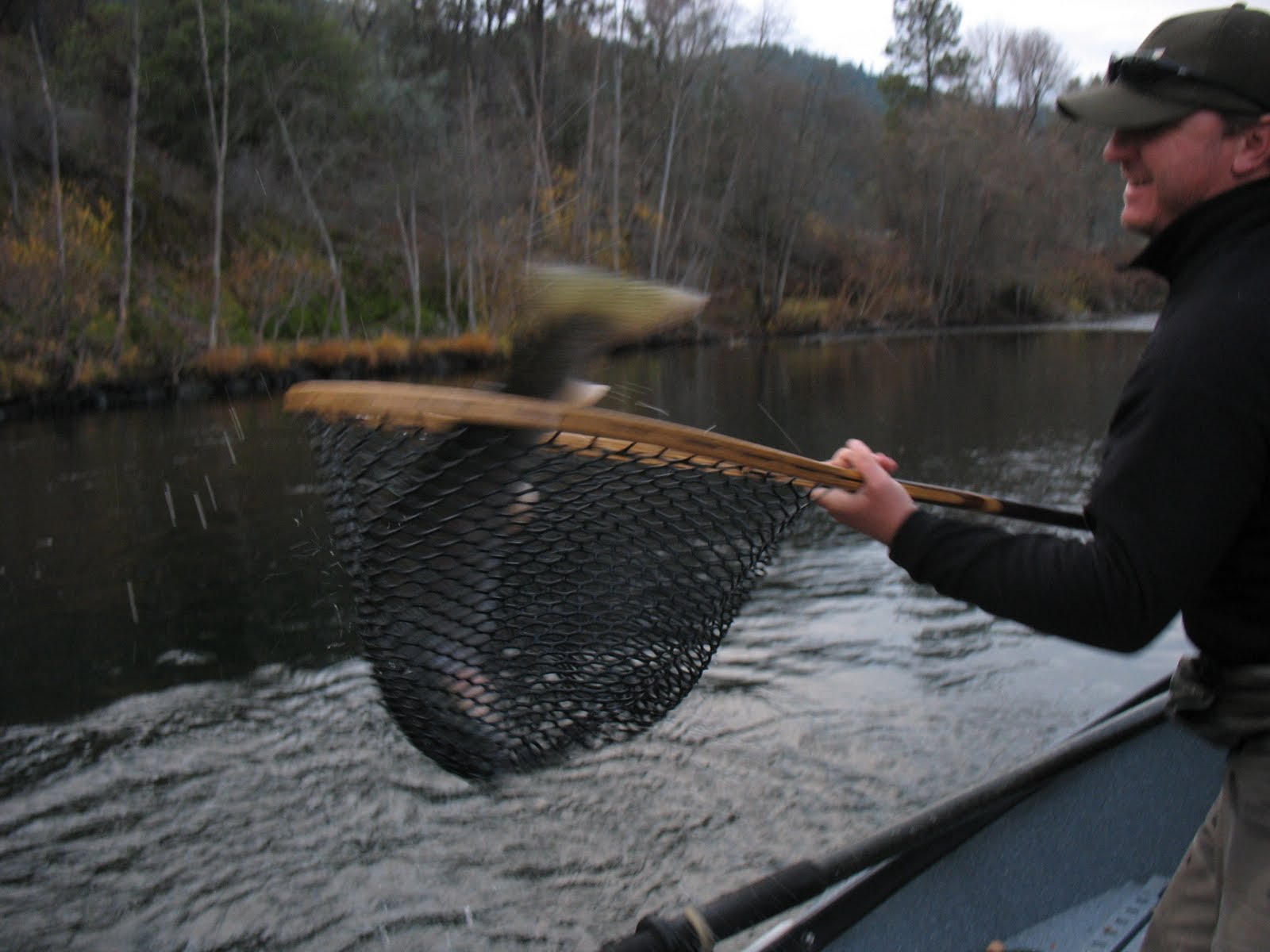
When we got closer to the take out we got to another deep slot that has a history of holding fish. There's a shear rock face that goes straight down into the river and creates a deep slot along the river right side. The run is probably 200 ft long. The water in this run moves slowly downstream and there is a foam line that you run your flies along. "Foam is Home." Sure enough my indicator had a slight down and I was hooked to a large steelhead. This was the perfect place to hook a large steelhead, but landing this fish was not easy. We worked and worked it and finally were able to secure it in the net. Whew!


That's a big fish in a big net!

This could be you. I've got to get back up there, its been too long.


Once again, Mike Hibbard, you are the man! I'll tell you now and I'll tell you again in the future. Call Mike for a day with an exceptional and hard working guide. Mike is a independent guide and takes pride in that fact. If you want to find out how to fish the Lower Sacramento River and the Trinity River give him a call.


Make a trip to the Trinity a "Tradition"


Wishing everyone and all of your loved ones a wonderful Thanksgiving.


Clay


You can contact Mike Hibbard on his cell phone at 530-526-5535
You can check out Ken Morissh's flys and the Anato-May at www.idylwilde.com


You can see this blog entry and past ones at http://www.flyfishingtraditions.com/